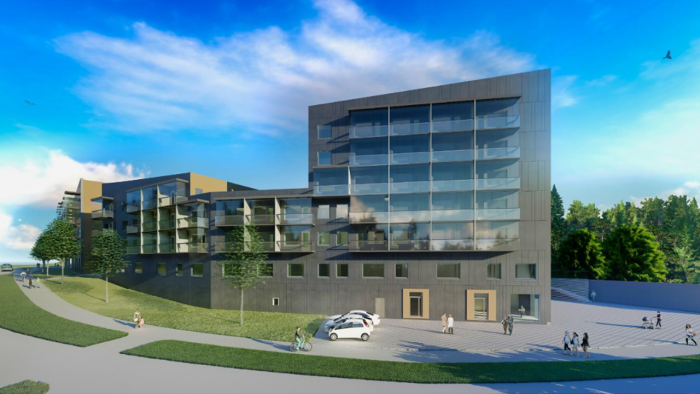
Aedifica completes 11 development projects across Europe

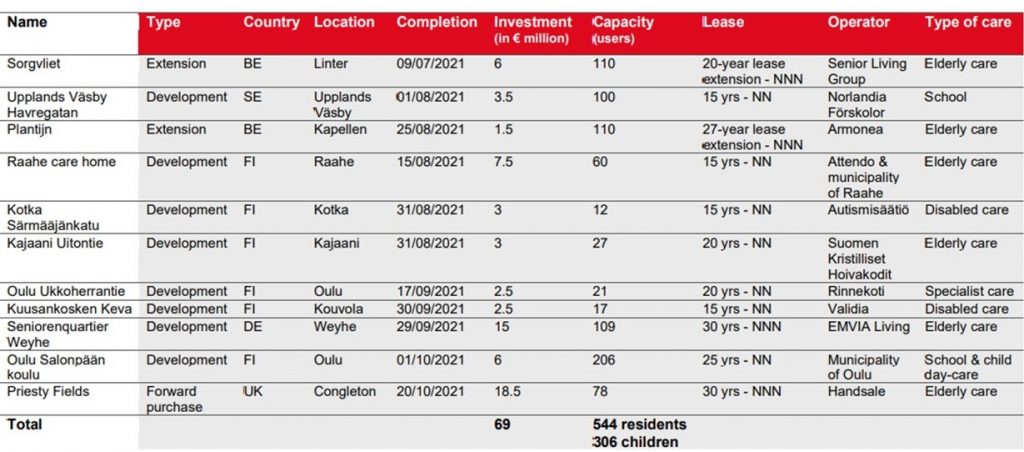
In August, September and October 2021, 11 development projects from Aedifica’s investment programme were delivered in Belgium, Germany, the United Kingdom, Finland and Sweden for a total amount of €69 million. Welcoming up to 544 residents and 306 children, these brand-new care properties are operated by a diversified pool of well-established and experienced private and non-profit operators, as well as municipalities.

Stefaan Gielens, CEO of Aedifica, commented: “We are very pleased to announce that Aedifica completed 11 development projects from its investment programme in Belgium, Germany, the United Kingdom, Finland and Sweden over the past three months, totalling €69 million. These brand-new care facilities were specifically designed to put their users centre stage and welcome up to 544 residents and 306 children. The projects in Finland and Sweden were designed and developed by Hoivatilat. We look forward to continuing to develop and invest in futureproof healthcare real estate with our local teams

Total investment: approx. €69 million

Total capacity: 544 residents & 306 children

Properties located in Belgium, Germany, the United Kingdom, Finland and Sweden

Diversified tenant pool of experienced private and non-profit operators, as well as municipalities.

Shift to higher quality in senior housing and healthcare sector

Having a pan-European strategy in the senior housing and healthcare sector is difficult as there are still differences in culture, market requirements and legislation, experts told Real Asset Insight.

“You really need local expertise and a good relationship with operators because regulations vary so much from country to country and sometimes within a country,” said Sabine Geuss, senior fund manager, healthcare, Principal Real Estate Europe. “In Germany for example every federal State has its own regulations and there’s always the risk of change.”

It is good to share best practice and import models from other countries, but it does not always work.

“So far we’ve focused on France and Germany but we would like to expand to the Netherlands, the Nordics and Austria,” said Nikolai Schmidt, managing director transaction healthcare, Swiss Life Asset Managers. “The problem is that they are very fragmented markets and each has its own regulations.”

Regulations can be a hindrance and a complication but when it comes to ESG and quality requirements it creates the right kind of competition, experts agreed. It actually helps to differentiate between companies, giving the best ones a competitive advantage.

“Regulation is not just part of our business but it’s also an opportunity,” said Frédéric Dib, president, Mozaic Asset Management. “It creates liquidity and consolidation, pushing bad players out of the market and allowing new entrants. It has also helped operators improve and become more professional.”

There is a definite shift to quality which will benefit the sector.

“The institutional capital we work with are targeting best-in-class operators,” said Stephen Miles, executive director, head of operational real estate investment continental Europe, CBRE. “Reputational risk is a real concern in this sector so operational excellence is a pre-requisite and it’s pushing out the lower part of the market and pulling quality standards up.”

ESG focus is helping to improve quality of property and operations

The focus on ESG is improving the quality of real estate and of the operational side as well.

“There’s an increasing differentiation in the market between buildings and between players, whether they are ESG-compliant or not,” said Charles-Antoine van Aelst, Chief Investment Officer, Aedifica. “Over time there’ll be a benefit on the valuation side as well. But it’s already a win/win situation.”

Stricter regulations and the lessons learnt during the pandemic are leading to improvements and upgrades which are positive for residents as well as staff.

“The operational side has been suffering and it will take time to recover from several waves of Covid-19 that had dramatic consequences,” said Benjamin Cabanes, director real estate, Korian. “But we’ve been improving our portfolio to make is easier to recruit staff. We need to be more attractive as an employer, so we are investing massively in human resources and in our buildings.”

Recruiting staff has become a problem for the sector. Companies like Korian are looking abroad but also targeting the young with apprenticeships and improving working conditions for everyone.

“Technology helps in many ways, but dealing with elderly people is a people business, it really needs human interaction, which is why the availability of qualified staff is such a critical issue,” said Schmidt. “It has become the biggest challenge for the sector.”

Author: Nicol Dynes, Real Asset Media

senior housing in Europe

EXPO REAL: No let-up in demand for senior housing across Europe

The senior housing and healthcare sector has proved its resilience and its potential during the pandemic, leading to increased demand and interest, experts agreed at Real Asset Media’s SHHA briefing at Expo Real last week.

“I’m very excited about the sector. Appetite did not diminish during the pandemic, because it is driven by macro factors,” said Stephen Miles, executive director, head of operational real estate investment continental Europe, CBRE. “Investor volumes have held up better than other asset classes and there is no let-up in demand. The real problem now is supply.”

Provision remains low across Europe. In the UK, senior living accounts for less than 4% of housing stock.

“We need a lot more product in senior housing and in healthcare,” said Nikolai Schmidt, managing director transaction healthcare, Swiss Life Asset Managers. “Now there is an incentive to build new facilities because investors are interested, they have seen how resilient this asset class has been during Covid-19.”

The entrance of new players is expected to give a boost to the sector, lead to more investment in real estate development and go some way towards reducing the current supply/demand imbalance.

“Investors have realised that these facilities are critical and the market is large, so they are diversifying from offices or retail into the sector,” said Frédéric Dib, president, Mozaic Asset Management. “There’s clearly a lot of growth ahead for the sector to meet what is a real need in society.”

Demographics is the key driver

On the demand side, demographics is the key driver as the baby-boom generation will soon join the ranks of over-65s. By 2050 the number of people over 85 will have doubled.

The different aspects of hospitality are expected to grow in importance as senior housing becomes more of a residential product. Miles called it “the hotelification process”, as more amenities and more services are on offer to meet residents’ demands.

“There is such a high demand for healthcare that new products are being developed,” said Sabine Geuss, senior fund manager, healthcare, Principal Real Estate Europe. “We’ll have more diversified care facilities. On one side there’ll be activities for people, a chance to have coffee together, socialise and be part of the community, while on the other there will be medical centres and specialised clinics.”

The mixed-use trend in real estate extends into senior housing and healthcare to offer more flexibility to residents and investors alike.

“We see a shift to assisted living where residents can choose their accommodation, their meals, their services and amenities,” said Schmidt. “They want to stay in one place, so if their health deteriorates they can remain in the building and receive more assistance.”

There will be more choice across the spectrum of needs. “We hope to be supported by local regulations so we can create the new products the market demands,” said Geuss.

Author: Nicol Dynes, Real Asset Insights

JV sets up €500m platform to target Shari’ah-compliant assets in Europe

A joint venture between the Capital Bay Group and Gulf Islamic Investments (GII) is setting up a platform for Shari’ah-compliant investments in retirement homes in Europe, targeting assets with a core-plus and value-add focus. The platform, regulated in Luxembourg, launched in September with an initial €500 million offering focused on real estate investments in income-producing properties located initially in Germany and then potentially expanding to other countries in Continental Europe. “The development of attractive investment opportunities in the European senior living real estate market enables our MENA-based investors to participate in this highly desirable asset class which would otherwise be difficult to access from the region,” said Mohammed Alhassan, founding partner and co-CEO of GII.


The joint venture was established to maximise cross-border synergies, the two groups said, joining GII’s capabilities with the knowledge and experience of Capital Bay, a company that has been at the forefront of healthcare real estate in Europe. “With our platform and network we are delighted to offer GII, a successful and experienced global investor, the opportunity to enter and participate in this fast-growing market segment and create the urgently-needed supply for this segment,” said Rolf Engel, group CFO of Capital Bay Group, and CEO of Capital Bay Fund Management.


The expectation is that a growing senior population in Germany and Western Europe will lead to increased demand for all forms of senior living, assisted living, healthcare and specialised clinics for elderly people. According to Engel the German healthcare market, with its extensive fragmentation of more than 2,000 operators, predominantly managed by
private investors running two or three nursing homes on decentralised sites, represents a particular barrier to entry. Hence the need for a foreign investors to team up with a local specialist. “Our tailor made platform allows us to act
locally for our society and community by joining hands with established international capital,” said George Salden, CEO of Capital Bay Group. “We truly believe that this offering will deliver superior risk-adjusted returns to investors around the globe.” The platform has a long-term outlook and will focus predominantly on manage-to-core and upgrade-to-core investments.

Responsible Housing to list on
the LSE to raise £250 million

Responsible Housing REIT is targeting a listing on the main market of the London Stock Exchange to raise £250 million to invest into a diversified portfolio of supported housing accommodation across the UK.


In its intention to float announcement the group said it would deliver a sustainable income with low volatility to investors, underpinning a minimum 5% dividend yield target with a total NAV return target of a minimum of 7.5% per annum over the medium term. Publication of the results of the share issue and the admission of ordinary shares was expected by the end of September.


The REIT is seeking to acquire and develop assets to address a lack of quality accommodation for supported residents across a number of care sectors. According to the group, demographic trends strongly support the sector. Projections suggest that the overall number of supported homes may increase by 30% by 2030, rising from 650,000 to 845,00 in the UK. Demand is also expected to arise from the continued implementation of the government’s Transforming Care Agenda, which aims to improve the overall quality of care.

Properties will be let on tailored leases with a variety of lengths to registered charities, housing associations, community interest companies and other regulated organisations with a proven operating track record. Leases will be aligned to the length of care provision packages and underlying contractual documentation and, where appropriate, contain break options. This is a new model which seeks to balance the needs of registered providers and investors and which will ensure transparency in the setting of rents with benchmarking against private market rents.


The company will be managed by BMO Real Estate Partners, part of BMO Asset Management. Responsible investing is a core competency of BMO, which has £8 billion of AUM in responsible funds. “We believe the Responsible Housing REIT model offers a new and compelling proposition for investors,” said Guy Glover, lead manager at BMO.

CEE healthcare market offers opportunities to investors

The CEE region is fast becoming a test-bed for advanced healthcare in Europe and offers great opportunities for investors, delegates heard at Real Asset Media´s Senior Housing and Healthcare investment briefing, which was held online recently on the REALX.Global platform.

Martin Zsarnóczky.
¨In the region there are many start-ups in the care and health sector that are becoming competitive at a global level,¨ said Martin Zsarnoczky, project leader, investor advisor, developer, Matra Resort Senior Living. ¨From a survey we have done, it emerges that CEE is seen as the most investable region in Europe.¨

The pandemic has highlighted the lack of adequate public services and the need for private sector intervention.

¨There are long waiting lists of five to six years to access state nursing homes and very little private offer,¨ said Zsarnoczky. ¨In any case the private sector is focusing on Warsaw, Budapest and the main cities, but 80% of the population lives in the countryside, so that is a huge untapped market¨.

The hope is that international players will come to the region, improve standards and introduce best practice, attracted by the potential of a market of 300 million people, he said.

¨Poland never had a good public health system and now with Covid-19 and an ageing population the problems are coming to the fore,¨ said Kristof Jacunski, CEO, president of the board, founder, Origin Polska. ¨There´s a large population of senior citizens that need good quality private care, especially in rehabilitation.¨

Travel restrictions during the pandemic meant that Poles working abroad could not help their elderly relatives.

Covid highlighted inefficiencies in the public health sector
¨People saw the need for senior living communities, where professional care is available,¨ Jacunski said. ¨The market has really shifted in the last year, because Covid has shown the inefficiencies of the public health sector and forced people to rethink the way they live.¨

Origin Polska is building a large complex in Northern Poland, its third in the country, with senior apartments for almost independent senior living in a community with ReVital wellness centres attached.

Another factor that plays in CEE´s favour is its geographical location. Poland´s proximity to Germany, for example, has created a market for senior living and healthcare facilities for German pensioners at a lower cost than in their home country.

¨Cross-border services will become more and more important,¨ said Jacunski. ¨There are many centres in Poland where only German is spoken. On the Baltic coast, 80% of occupants are German who are there for senior living with rehabilitation facilities. The demand is there regardless of income, and this creates a huge opportunity for us to build a level of quality that is well recognised in Europe and worldwide, but at a much lower cost.¨

Author: Nicole Dynes, Real Asset Media

Technology helps in healthcare but people always come first

Technology can make a huge difference in the senior housing sector but it comes second to people, delegates heard at Real Asset Media´s Senior Housing and Healthcare Investment Briefing, which took place online this week on the REALX.Global platform.

¨Ours and will remain a people-centred business,” said Thibault Sartini, CEO of the cluster new countries, Orpea Group. ¨Technology is useful but it cannot replace people. It is important to find the right mix, but keep in mind that ultimately you need people to take care of people.” 

Designing and developing the right buildings with great facilities is important, but training is crucial for the delivery of quality care.

¨It is easy to invest in the building, but it´s what happens inside the building that matters,”  he said. ¨That is down to the people, who are the main resource we have¨.

The social impact aspect of senior housing includes looking after your staff as well as your clients, Sartini said: ¨We take good care of our employees so that they´ll take good care of our residents.”

The lack of people to work in care homes and senior accommodation is an issue across Europe, where there is little or no attention paid to healthcare and social care at university, apprenticeship or secondary school level. Lack of awareness of the problem leads to the shortages that the sector is experiencing. 

Well trained people harder to find

¨We have an advanced robotic technology for rehabilitation in our centre in Poland but the problem is people,¨ said Krystof Jacunski, CEO, president of the board, founder, Origin Polska. ¨Without well-trained people you can do nothing with technology, and well trained people are getting harder and harder to find.¨

Origin has opened its own training Academy and Orpea Group is looking into doing the same to guarantee a supply of well-trained staff in the 25 countries they have a presence in around the world. The lack of people to work in care homes and senior accommodation is a problem across Europe.  

¨Finding the right people is difficult and in Switzerland four languages are spoken, which makes it even more complicated,” said Laura de Wit, CEO, president of the board, founder, Miller White Group. ¨We try to attract people from around the world but there are issues with work permits.”

One of the changes brought about by the pandemic is that senior citizens have discovered technology as a means of keeping in touch with children and grandchildren during lockdowns. 

¨Interestingly the number one demand in senior living now is a good WIFI connection, which is what the young want in student housing¨, said de Wit. ¨The young and the old are the same: they all rely on technology.”

Author: Nicol Dynes, Real Asset Media

Open door policy in senior housing ‘brings the outside in’

Author: Nicol Dynes, Real Asset Media
In the fast-evolving senior living sector there is an ongoing debate about the separation of independent residences from care homes and medical facilities, delegates heard at Real Asset Media´s Senior Housing and Healthcare investment briefing, which took place online on the REALX.Global platform recently.

¨Seniors who are healthy and wealthy want to live in a pleasant resort, use the swimming pool, play tennis and golf and lead an active life,¨ said Erol Riza, managing director, Mithra Capital Advisors.

¨They also want the reassurance that if something happens to them they can move into accommodation with some kind of assistance. But they don´t want the medical or dementia wing under the same roof.”

What is needed is a continuum of care, from independent living to assisted living to care homes, to cater for people´s needs as they arise. The question is how to go about it in practice.

Different solutions are being explored. In Canada, Origin has a building with independent living on one side and a separate but connected wing for dementia patients.

¨It is important to be in the same building because often in a couple you have one person who is self-sufficient and the other with dementia,¨ said Krystof Jacunski, CEO, president of the board, founder, Origin Polska.¨There is a very discreet, invisible combination so that husband and wife can still be together even if one of them needs assistance and the other does not.”

Healthy people want sports facilities, not a nursing home next door

Healthy people do not like to live next to a nursing home, he said, and they want wellness and sports facilities so they can take care of themselves and lead good quality lives for longer. But they also want to know they can have immediate assistance when they need it, which is not something the state sector can always provide.

A similar debate is happening about whether discretion or openness should prevail in senior residences.

¨We have an open door policy in our residences because we believe in bringing outside life in,¨ said Thibault Sartini, CEO, cluster new countries, Orpea Group. ¨Even office workers can come and eat in our restaurants, which is good for everyone.¨

Special units can be kept separate, but it is positive for independent seniors to maintain their lifestyle as much as possible after they retire. Studies show that keeping physically and socially active can slow down early stage dementia, giving people an extra lease of quality life.

¨We should not hide people away when they are no longer 100% healthy,¨ said Laura de Wit, CEO, president of the board, founder, Miller White Group. ¨It is a worrying tendency that we should combat.”

Aedifica invests €22million in five care properties in Finland

Aedifica invests €12.5 million in the acquisition of a portfolio of 3 care properties in Kokkola (Finland). Stefaan Gielens, CEO of Aedifica, commented: “Aedifica is very pleased to announce that Hoivatilat further expands our Finnish healthcare real estate portfolio. We will invest a total amount of approx. €22million in the acquisition of three fully operational care properties and the development of two new projects, accommodating a total of 261 residents and children. We look forward to continuing to invest in futureproof healthcare real estate with our Finnish Hoivatilat team.” Jussi Karjula, CEO of Hoivatilat, commented: “As part of the Aedifica group, our strategy also includes the acquisition of high-quality fully operational care properties, in addition to our own active project development work. I am pleased with the acquired assets and new development projects, which complement our current portfolio nicely. Together we are creating a better society.”

Description of the sites

The 3 care properties are located in Kokkola (48,000 inhabitants) and were built between 2011 and 2016. Ilkantie 1 is located in the centre of Kokkola and accommodates 56 elderly people and 17persons with a disability requiring continuous care. The Metsämäentie 62 and Kärrytie 1 care homes are located in the proximity of the city centre and are specifically tailored to suit the needs of elderly people requiring continuous care, accommodating 26 and 23 residents respectively.

Description of the operators and the leases

97 units of this portfolio are operated by Attendo, an established private player in the Finnish elderly care sector that currently operates approx. 13,000beds. The Attendo group has almost 40 years of experience in the healthcare sector and is the largest private care service provider in the Nordics, employing over 24,000 staff in more than 700 locations. The group already operates 29 Aedifica sites.

17 units of this portfolio are operated by Soite. Soite is a public operator of several municipalities operating in the Central Ostrobothnia region. It offers primary and specialized health care services and social services. Soite was established in 2017 and employs 3,800 people.

8 units of this portfolio are operated by Kårkulla. Kårkullais a public operator that provides support and services to people with intellectual and other disabilities and their families. Kårkulla consists of 33 bilingual municipalities and provides services throughout the Swedish speaking regions in Finland. Kårkulla has approximately 1,000 employees.